CINCINNATI'S HISTORIC MUSIC HALL BALLROOM

Articles about the renovation of the ballroom in the late 1990s.

promotional photo of the new Music Hall Ballroom
The Ballroom in Cincinnati's historic Music Hall can be rented for parties, dances, performances or other events.

To inquire about available dates or to arrange for an event at Music Hall in the ballroom or in any area of Music Hall, please call the Music Hall office at (513) 621-1919.

The Music Hall Ballroom's main stage will be renovated to accommodate the donation of the Mighty Wurlitzer organ that originally played at Cincinnati's RKO Albee Theatre. Click here to read more.

Music Hall Ballroom Renovated
Elegance partners with nostalgia at Music Hall

The new Ballroom Ceiling
Photo by Michael Keating/The Cincinnati Enquirer
BY JANELLE GELFAND
The Cincinnati Enquirer
October 10, 1998

For many of those entering the newly restored Music Hall Ballroom on Friday night, it will be difficult not to experience a bit of deja vu.

The bronze-and-glass doors that open onto the glamorous space once graced the Albee Theater, the grand Depression Era theater/movie palace that stood on Fifth Street for half of this century.

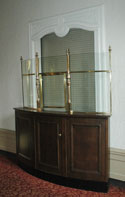
Outside the ballroom doors, the Albee's walnut and brass ticket booth sits, as if waiting for crowds to appear for the next big feature.

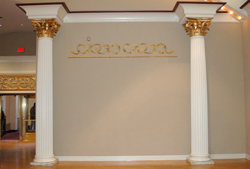
columns from the Albee Theatre Pilasters, columns, filigree cast-iron railings and story-high etched mirrors that flanked the Albee's marble staircase are a few of the fixtures enhancing the $1.8 million renovation of Music Hall's South Wing Ballroom.

The ballroom reopens Friday with a sold-out, black-tie fund-raiser. Proceeds will go to the makeover, the first in 39 years.

The nostalgia will be twofold for those who remember the Albee and who played swing, danced or attended high school proms in the ballroom.In the ‘30s, ‘40s and '50s, "the ballroom was filled for public dances every Wednesday and Saturday night says Robert Wheeler of Springfield Township, who played in big bands there. "People came from all different stratas of society."

"It was the place to go for Formal dancing in Cincinnati, " says Robert Dominique of Anderson Township, Western Hills High School Class of '48.

The room, then called the Topper Club for whites and the Graystone Ballroom for African-Americans, had a stardust ball and Egyptian decor that included a sphinx.

"The young people went to the swing bands, and a lot of jitterbugging went on," Mr. Wheeler says.

"All the big bands played there. I heard Woody Herman there in the '30s and '40s," says trumpeter Pierson Dejager of Fairfield, who played in bands throughout the city. "It was extra swanky."

"The big thing was the graduation dance," says Janet Greiner of Westwood, Western Hills High School Class of '51. "We graduated in Music Hall in long white dresses, then we walked over to the Topper Club."

It "had a glamorous look," says 1993 Walnut Hills grad Torrie Hesser of Hyde Park. Her junior-senior prom rocked and rolled to a disc jockey there.

But the popularity of the glittery room, once busy every night, faded. Before being closed in May for the renovation, bookings had dwindled to two nights a week.

"It seemed like it couldn't possibly be a part of Music Hall," says Gary Barton, announcer/librarian at WGUC-FM (90.9). "I was impressed with the seediness of the place."

For the first time, the ballroom radiates old Cincinnati. The most recent renovation, in 1959, had an Hawaiian theme and featured the world's largest color photo mural of Diamond Head and Waikiki Beach.

Gone is the low ceiling; the room is cavernous. Elegant white and gold pilasters line softly lighted taupe walls. A gleaming white oak floor shines under six tiaras of marquee lights skimming the high arched ceiling.

The Albee pieces provided a solution for Don Beck of Beck Archititecture, Inc. He needed a decorative theme that would fill the room."

It was a daunting task. With 18,000 square feet (about three times the size of the Omni Netherland's Hall of Mirrors, the ballroom can accommodate up to 1,500 revelers.

"It's a very big space, but without the artifacts, it would just be another empty hall," Mr. Beck says.

Design details include an enlarged bar finished with mirrors and a wooden railing from the Albee. Two new restrooms have mirrors and paneling from the Albee's luxurious lounges.

Mr. Beck's other challenge was to unify the ballroom with the rest of Music Hall's neoclassical interior featuring columns and simple lines.

Where a low ceiling once covered a third of the room, a 24-foot high, barrel-vaulted ceiling now spans the entire 200-foot length.

The face lift includes state-of-the art lighting and sound systems, designed to attract a variety of tenants.

The ballroom's renovation was undertaken by the Cincinnati Arts Association (CAA), which manages Music Hall, Memorial Hall and the Aronoff Center. It was financed by a commercial loan issued through Hamilton County, to be paid back through higher rental fees and more bookings, says Ernest Toplis, Music Hall manager.

No one can say yet whether the grandeur has been returned to the ballroom, but every weekend through May is booked, and daytime slots and weekends are filling up, says Mr. Toplis.

divider

Music Hall ballroom will use Albee fixtures

BY OWEN FINDSEN
The Cincinnati Enquirer
February 13, 1998

When Cincinnati's favorite theater, the Albee, was torn down in 1976, Pat and Joe Perrin rescued much of the decor. Now they're donating it to Music Hall, to be used in the renovation of the ballroom.

"The Perrin's did a lot to rescue these items and keep them together all these years," says Mount Auburn architect Don Beck, who is designing the ballroom. "They used them in their furniture showroom, Perrin Interiors in Springdale, and now that they're retired, they want to make sure the whole collection stays together."

The 22,000-square-foot Music Hall Ballroom is Cincinnati's largest event room outside of the Albert Sabin Convention Center, "but it is just a big room," Mr. Beck says. It has no distinctive style. Fortunately the Albee's design was in the same Beaux Arts style as the Music Hall's late 19th century renovation.

"We have no chandeliers or lighting fixtures from the Albee," Mr. Beck says. "Those were sold separately, but we have pilasters, brass railings and a lot of architectural fixtures. If we don't have enough for our design, we will make duplicates of the original items. We'll use everything we have from the Albee."

The $1.8 million renovation, which will be completed in October, will include two new performance stages, new restrooms, refurbished walls and entrances, a new floor and ceiling.

"Originally the room had a barrel vault ceiling that's been gone for years. We're making a new one. The Albee didn't have a barrel vault ceiling, but it did have a coffered ceiling, and our ceiling will be coffered in the same design that was used in the Albee and in Music Hall," Mr. Beck says.

The Albee, on Fifth Street between Vine and Walnut, opened on Christmas Eve 1927.

Return to the Opening Page